Making Soap (with pictures!)

When I make soap, I break it out into in several stages: Preparation, Melting, Mixing & Molding, Unmolding & Cutting, Trimming and Packaging. Generally there is a time gap between the different stages – sometimes hours, sometimes days and even sometimes months. This is how I do it.

Preparation

Over the years I have developed several basic recipes which I use for the majority of my soaps. That being the case, in preparation of soap making I pre-measure oils and lye for 20 or so batches all at once. I also measure out lye for 16 batches at one time, storing it in tightly sealed, heavy-duty plastic pitchers.

Measuring the oils and fats is pretty straight-forward. I used sealable plastic tubs and ziplock bags, combining the ingredients based on the melt temperature.

The lye requires measuring the water and lye (by weight). I put the water in all the pitchers first, and then quickly add the lye, mix and put the tops on. Once the lye hits the water it gets very hot and also gives off a nasty smell so leave my shop for several hours after the mix.

Melting, Mixing and Molding

When I’m ready to make soap, the first step is to melt down the oils and fats, so they are liquid. The hotter the oils and lye, the faster the soap chemistry happens, so I try to heat my oils only as much as is absolutely needed to melt them. Olive and Castor oils are already liquid, so they go in the pot at room temperature. The remaining oils are melted in a pot on a flame or in the microwave. Once everything is melted, it goes into a five-gallon bucket to be mixed.

I use a drill press, fitted with a long squirrel mixer to actually mix the soap. The pre-measured batch of lye gets poured in and any additional ingredients (colorants, scents, herbs, etc) are added when the soap is starting to thicken.

Once the soap is about the consistency of thin cake batter, I pour it into silicone lined soap molds (purchased from the Upland Soap Factory) and then wrap in blankets to keep the heat in. In the winter I use an electric blanket, but during the summer I only need a light blanket.

Unmolding & Cutting

After the soap has been in the mold for 24 – 48 hours (sometimes more if I get too busy), it is unmolded, cut into bars and put in my drying closet that has a dehumidifier to help the curing process. I took some pictures the last time I unmolded and cut:
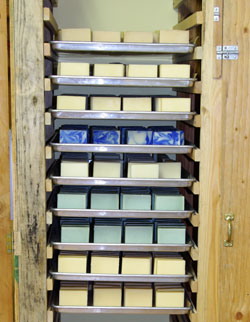
The trays are placed in the drying closet which holds about 1500 bars of soap. A small marine dehumidifier is in the closet, helping to pull the moisture out of the soaps. Most soap cures in about 10 days.

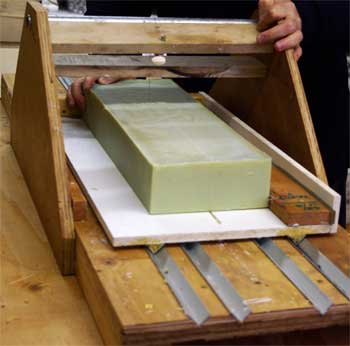
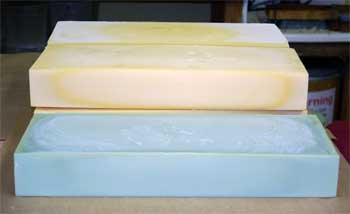
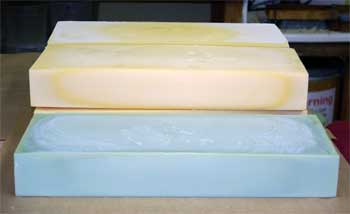
Soap Loafs Each mold makes a loaf that is 18 bars long and 2 bars wide, totaling 36 bars.
Soapmaking - loaf cutter The loaf cutter cuts down the center of each loaf, making two separate loaves, each one the size of 18 bars stacked together.
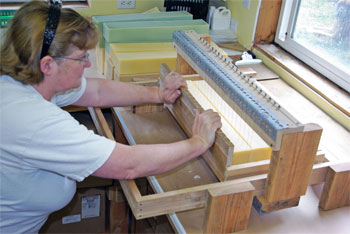
Soap-O-Matic soap cutter The soap cutter (we call it the Soap-O-Matic) uses guitar strings to cut the loaf into 18 bars. I expect there is an easier machine to do with, but it certainly was an interesting project when we built it!
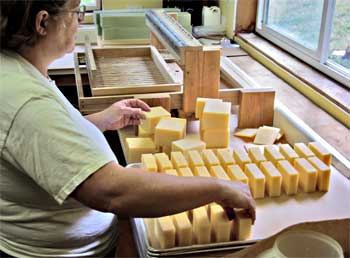
Soap on Drying Trays Once the bars are cut to size, they are placed on bakers trays double-lined with kraft paper. Leaving space between the bars helps them to dry faster.
Soap Drying Rack The trays are placed in a drying closet that contains a marine dehumidifier to dry the soap quickly. Bars are ready in about 7 – 10 days.
Share and Enjoy:
  • Print
  • Facebook
  • Twitter
  • Google Bookmarks
  • LinkedIn
This entry was posted in Soapmaking. Bookmark the permalink.

29 Responses to Making Soap (with pictures!)

  1. connie says:

    Dear Marie,
    I sent a paint mixer fitted to a drill, for my sister who makes goats milk soap in the Philippines. Unfortunately it melted while mixing the caustic soda (lye) and milk. Is the squirrel mixer you use, a stainless steel one? If so, where can I purchase the item? Hoping for your response.

  2. david dewing says:

    HI what is a “marine dehydrator”. and where may I get one . As for calculation soap from a mostly square molds find square inches of mold lenght x width x height then divide but 2.625, this will give you oz. this works for me using the mms calculator http://www.thesage.com/calcs/lyecalc2.php not sure about soap calc http://www.soapcalc.net/calc/SoapCalcWP.asp but they all deal with ounces, weight not volume, so it should not make any difference ty Dave

    • marie says:

      Hi Dave,

      A “marine dehumidifier” is a strong dehumidifier that’s designed to go on boats to keep the ambient moisture down. The one I got was from a marine supply site.

  3. Penka says:

    Hi Marie
    I was wondering
    1. why my soap is difficult to cut. It is too hard even if I play around with more soft oils or forget about discounting water. How come you unmold and cut whenever you have time? What’s the secret?
    2. Do I understand correctly that you mix oils at melting temperature and lye at room temperature, as I read that you prepare the solution well in advance?
    Penka

    • marie says:

      Difficult to cut soap can be a couple of different things. If you leave the soap too long, it can get quite hard to cut. Cutting too many pieces at once can be a problem. Soap made with a high amount of “hard” fatty acids (stearic acid, from palm oil or lard, especially) can be very hard. Soap with high amounts of coconut oil can also be hard to cut. The best solution is to cut the soap pretty soon after your make it (when it’s still soft).

      Yes, I mix the oils at melting temperature (sometimes cooled down considerably … I like them around 100 – 100) and the lye at room temp (and where I am, in the winter, that’s pretty cold!). By mixing at lower temps the trace time is longer, giving a bit more control.

  4. erlina says:

    is it true that most soap cures in about 10 days?? only ten?..i read it before somewhere that natural soaps (using cold process) need about 3-5 weeks to cure..

  5. Shelia Arnett says:

    My husband always takes soap out of the package and leaves it in the linen closet saying the moisture will evaporate and the soap will last longer. Is that true? These are store bought soaps not home made or speciality soaps.
    thanks
    Shelia

    • marie says:

      Yes, generally that’s true. When soap is made there is water in it – as the water evaporates it gets harder and harder (and so it takes more water to make it dissolve when you use it). I have some commercial soap that’s about 50 years old and it is HARD!!

  6. now that is a tip i would like to incorporate…your handmade soaps cures in 10days?! Thats amazing!!!

  7. Cindy says:

    Hi Marie

    It’s me again..Cindy. I’m trying to make perfect goat milk soap but my big problem is the scents that I added about 1 ounce
    per pound of soap didn’t last long. It is fading out during curing time a lot. It only happens when I make large batch of soap.
    Could you give me advise how to make the scents last long?

    Thank you
    Cindy

  8. Cindy says:

    Hi Marie

    Thank you very much for your explanation. It helps me a lot.

    Thanks again
    Cindy

  9. marie says:

    Hi Cindy,

    I don’t sell a soap cutter. The sites listed above do sell various types of soap cutters – you should check with them.

    As for the “curing time”. Soapmakers generally refer to “curing time” as one thing, but actually it’s a two stage process.

    First, is the time necessary for saponiifcation. Most well made soap doesn’t have any free alkali by the time the soap is completely cool (when the reaction process is completed). However, the amount of water and the percentages of certain oils can make a small difference here. See The Water Discount by Kevin Dunn at the Handcrafted Soapmakers Guild website for actual experiments on the effects of oils and water on the amount of free alkali.

    Second, is the time necessary to evaporate out excess water and get the bar harder. This is a factor of the “art”. The soap is soap, but the hardness of the bar improves as moisture evaporates. The harder the bar, the longer it will last.

    For my formulations, the saponification is complete when I unmold the soap. So my “curing time” is designed to remove the moisture and make the bars harder before I package them. Using the marine dehumidifier helps speed that process along considerably, which is why I can package my soaps within 7 – 10 days (or even sooner if necessary).

    In most cases, soap continues to “cure” (the water evaporating out) for a long time. Assuming nothing else happens, a very old bar of soap will be very hard, and considerably lighter than when it was first cut. I have an old bar of coconut soap from the 1940′s which is like a ROCK!

    This is a factor to take into account when packaging and labeling your soap. The stated net weight on the package CANNOT be more than the actual weight of the bar, and it will continue to dry and harden for weeks or months. So if the soap weighs 4.0 oz when you package it, down the road the actual weight of the bar may be 3.5 or 3.7 oz. That can be a problem if your package says 4.0 oz.

    Whenever you are packaging your soap, make sure that the stated net weight is the SMALLEST amount you expect the bar might be when you actually sell it.

    Marie

  10. Cindy says:

    I’m looking for a soap strip cutter. It is very hard to find even online. I like the only that you are using. Do you have it for sell? By the way, How can you cure your soap only 10 days? Is it save for skin? I heard that there is lye solution still left over about at least 5% after saponification. That’s why most soapmakers cure their soap at least 3 weeks. I think it’s good idea if I can cure my soap only 10 days. Could you explain?

    Thank you
    Cindy

  11. canon hoei says:

    Dear Marie, I’m interested in making the cutter by myself, could you send me the picture of the cutter in a full page size? Thanks for your kindness.

    Best regards,
    CANON
    Indonesia

  12. Mary Lou says:

    Hello,

    I love the soapmaking and pictures on this page, I have learned alot. I am begining to make goat milk soap, and am wondering what brand and size the marine dehumidifier is you use.There are many kinds on the market, just want to get the correct one.

    Thank you, and love the web site!
    Mary Lou

  13. Dear Ma’am Marie its me again, Lourdes. I am really dying to know how I can have one cutter like the one in this picture.

    Please let me know. My email ad is ticanocah@yahoo.com

    God bless and Have a nice day ahead.

    Thank you.

  14. Wonderful! Great! I really love soap ..handcrafted soap.We no longer buy commercial bath soap but instead make our own and my whole family loves it.

    I am interested about the soap cutter. Hope you can give me an information how to have it. My email ad is ticanocah@yahoo.com.

    Hope to hear from you.Thank you

  15. Mary says:

    Dear Sir / Madam,

    Thank you for your soap pictures.

    Plse I am soap maker and I need the cutter machine urgently.
    Madam, kindly let me know the price of the machine and the terms of payment.

    Plse reply today with the prices.

    Thank you.

  16. gely says:

    Hi Marie, i wrote you from Mexico, i´m so interested in your drying closet, i have a dehumidifier, is it always turn on till soaps are dry???

  17. marie says:

    The recipe is one that I developed over time. Traditional cold process soap uses palm, coconut and olive oils – there are many recipes online for different types of soap. For my soaps I also add castor oil, shea butter, stearic acid (it’s tricky – best not to start with that), hydrogenated soy and palm kernel oil.

    You can calculate the right amount of lye for the oils you are using by hand (using math and the SAP values – the process is explained in Susan Cavitch’s book

    You can also use a lye calculator – I recommend the one on the Handcrafted Soapmakers Guild site here: http://www.soapguild.org/industry/lyecalculator.php

    It took me a while to get the batch size right for the molds – that’s kind of tricky. You can calculated it by volume and batch size, but in the end it may be trial and error.

    Good luck with your soapmaking!

  18. Cherinet says:

    Dear Mrie,
    I appreciate your effort in displaying your soap making procedures with colored pictures. I was curios to know how much of each reciepies you’ve used to obtain the 36 bars of soap. In other words, how much lye and oils have you used? Which types of oils are effective? Can I use palm oil? I’ve seen some other soap making techniques and yours look simpler. Regarding the equipments, no problem, I can make them at home.

    Best regards,
    Cherinet
    Ethiopia

  19. natural soap says:

    Thanks for your step by step soap making tutorial. That will help lots people looking for natural soap making procedure. But, if you explain where to find those instruments will really helpful.

  20. marie says:

    I don’t know of anyone who sells soapcutters in the UK, but you could check:
    http://www.soapequipment.com,
    http://www.creeksidesoaps.com, or
    http://www.missionpeaksoap.com.

    There are also some good directions for a do-it-yourself cutter at http://www.teachsoap.com/cutter.html.

  21. Gina says:

    I am looking for a cutter to cut my home made soap. Can you help with it I am in London.

  22. marie says:

    Yes, we made the soap cutter ourselves. It was QUITE a project!! We had a basic idea, but sort of designed it as we went along.

  23. suzanne orford says:

    hi
    i love the look of your cutters. did you make them yourself?
    best wsihes suzanne

  24. marie says:

    The equipment shown above is what we made to cut the soap. We mix in 5 gallon buckets with a drill press and a large squirrel mixer (like used for paint). We pour into silocon-lined molds from the Upland Soap Factory (www.uplandsoapfactory.com).
    Marie

  25. Mahaa s says:

    WE APRECIATE YOUR SERVICES BUT WE WOULD LIKE YOU TO ATLEAST DISPLY SOME OF YOUR MACHINES.
    THANK YOU.
    TRY TO REPLY.

  26. muhebwa says:

    I would like to know the type and model of machine that you realy use to make your soap other wise your work is realy so so good keep it up thanks
    hope to hear from very soon
    MUHEBWA ROBERT

Leave a Reply

Your email address will not be published. Required fields are marked *

*

You may use these HTML tags and attributes: <a href="" title=""> <abbr title=""> <acronym title=""> <b> <blockquote cite=""> <cite> <code> <del datetime=""> <em> <i> <q cite=""> <strike> <strong>

 
Copyright © 2012 Marie Gale. All Rights Reserved.